Artist · Argentine
Fernand Léger
Argentine, 1881-1955
Fernand Léger was a towering figure of 20th-century modern art whose dynamic vision captured the pulse of the machine age. Born in Argentan, Normandy, Léger initially trained as an architect’s apprentice and a photographic retoucher. After failing the entrance exam for the École des Beaux-Arts in Paris in 1903, he studied at the École des Arts Décoratifs and the Académie Julian, immersing himself in the vibrant Parisian art scene.
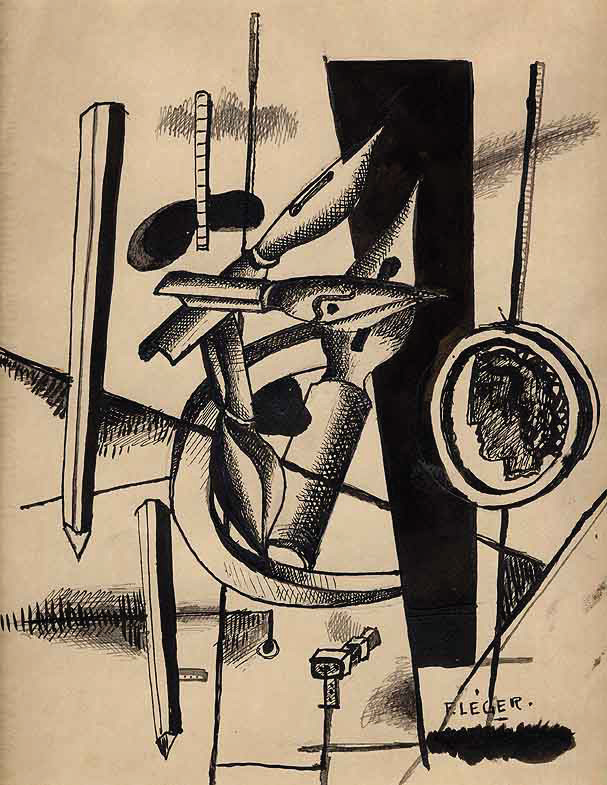
By 1909, Léger rented a studio at La Ruche and gravitated toward the Cubists. Associated with the Puteaux group, he exhibited at the Salon de la Section d’Or in 1912 and participated in New York’s historic Armory Show in 1913. His early association with the art dealer Daniel-Henri Kahnweiler helped cement his transition into Cubism. However, rather than adhering strictly to traditional rectilinear forms, Léger developed distinct abstract tubular and curvilinear shapes, earning distinction as the first Cubist to experiment with non-figurative abstraction.
His artistic trajectory was profoundly impacted by his service on the front lines during World War I. Returning to civilian life, he forged a close friendship with Le Corbusier and Amédée Ozenfant, co-authoring the Purist manifesto Après le cubisme in 1918. This movement championed sobriety, rigor, and synthetic forms inspired by the precision of machinery. During the late 1920s and 1930s, Léger’s work often featured meticulous, isolated objects floating in space, bridging the gap between Purism and Surrealism.
Forced to flee occupied France during World War II, Léger spent several productive years living and teaching in the United States. Upon returning to France after the war, his practice expanded into murals, stained glass, mosaics, and ceramics, reflecting his lifelong commitment to making art accessible to the broader public. Throughout his career, Léger remained intensely fascinated by the modern world, translating industrial technology, urban energy, and everyday machinery into an iconic visual language of bold primary colors and monumental, mechanical forms that still defines his enduring legacy.
Collection
Works in the Collection